In this article
Strong interview preparation does not require a dramatic rescue story. An ordinary moment can reveal how you work: noticing an error, explaining a choice, asking for help or following through on a handoff. The challenge is selecting enough detail for another person to understand your contribution without inflating the result.
Choose the task before the story
CareerOneStop recommends preparing for interviews and practicing your responses. Our evidence method makes that preparation specific: pick one responsibility from the live posting, then choose an event where you used a related skill. A stockroom example may fit accuracy; a volunteer event may fit teamwork. Neither needs to be recast as employment if it was not employment.
Ask whether your story answers the question. A successful group project might demonstrate planning but say little about handling an upset customer. If you do not have a direct example, explain the closest relevant experience and its limits. That is more useful than inventing a retail situation you never handled.
Use four pieces, then add reflection
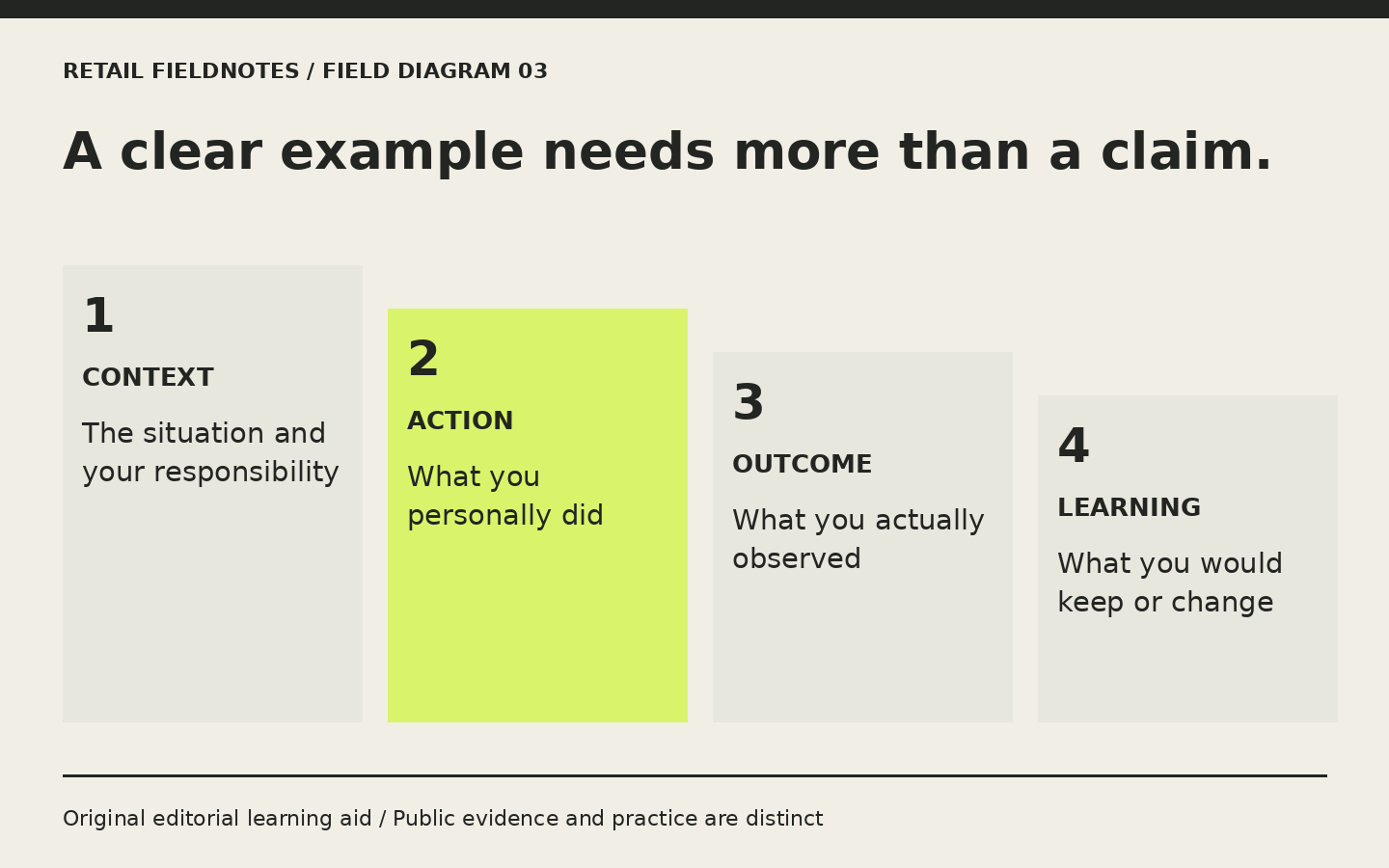
Set the scene briefly. Explain the responsibility you had. Spend most of your answer on your action: what you noticed, decided, said or checked. Describe the outcome you actually know. Then add one sentence about what you learned or would do differently. The reflection is especially helpful when the outcome was mixed.
Here is an invented practice outline: a pickup order did not match the label; the worker was responsible for handing over the right item; they paused, compared the order information and asked the authorized colleague to resolve the mismatch; the corrected item reached the customer. The lesson was to verify before handing over. This scenario illustrates structure, not an employer procedure or a story to present as your own.
Keep the evidence proportional
Do not borrow the whole team’s result as your individual achievement. “I handled the item check while a colleague spoke with the customer” shows cooperation and clear ownership. If you cannot verify a sales increase or time saving, leave the number out. Describe an observable result instead, such as completing the handoff or identifying a mistake before it continued.
Remove customer names, private incidents, internal reports and confidential performance figures. You can describe a process at a general level. An interviewer needs to understand your judgment; they do not need someone else’s personal information. Use the browser-local planner below only with its preset categories. It deliberately does not collect your story.
Practice a useful next step
Try saying your outline aloud once. Where did you skip your own action? Where did background detail bury the point? Revise that part rather than memorizing every word. Prepare a second example so you are not forcing one event to answer every question. The planner will suggest a practice focus based on the evidence pieces you mark; it does not grade candidates or predict hiring outcomes.
FIELD EXERCISE / NO STORY SUBMISSION
Interview Evidence Planner
Choose a practice focus and mark the pieces you can explain. Get a short rehearsal plan. This is an editorial learning aid, not an employer test, application or assessment of your chances.
Preset choices only. No names, story text, employer records or account information. This tool uses page memory only; it sends and saves nothing. Your browser may independently restore form state. Printing uses your browser’s page output and may include surrounding article text.
Make your choices, then build a plan. No information is submitted.
Use the planner without JavaScript
For a ten-minute rehearsal, spend two minutes choosing a truthful example, four explaining your own action, two checking the outcome and two deciding what you learned. If you cannot explain a piece, use that gap as your practice focus. Do not invent the missing detail.
For a customer example, practice how you clarified the request. For an operations example, describe the work state, exception and next owner. For leadership, explain how you supported another person within your authority. For a transition, connect a real skill to a destination task and name the gap. If the example is hypothetical, label it hypothetical rather than presenting it as experience.
Sources & scope
- Get ready to interview — CareerOneStop, sponsored by the US Department of Labor. General interview preparation and practice guidance. Editorial exercises are original, not an employer interview script.
Public sources checked October 12, 2026. Editorial methods and hypothetical scenarios are our own. Check the live posting before acting; this publication cannot confirm an opening, application status, employment terms or internal process.