In this article
A career transition is easier to investigate when “something different” becomes a specific work question. Retail experience can include communication, coordination, accuracy and learning under time pressure. The next step is to show where one of those skills applies and where the destination requires knowledge you do not yet have.
Pick a function, not a fantasy title
The company’s public corporate-careers page describes functions including digital, finance, human resources, technology, logistics, merchandising and planning. That breadth can support exploration, but it is not evidence that a current vacancy exists or that store experience automatically qualifies someone for a corporate role. Read a current role description in the function that interests you.
Ask what the team produces and who uses the work. A planning role may involve a different kind of analysis from a customer-facing role. An HR position may require knowledge and experience beyond being good with colleagues. Respect those differences instead of treating every office role as the same destination.
Build a three-part bridge
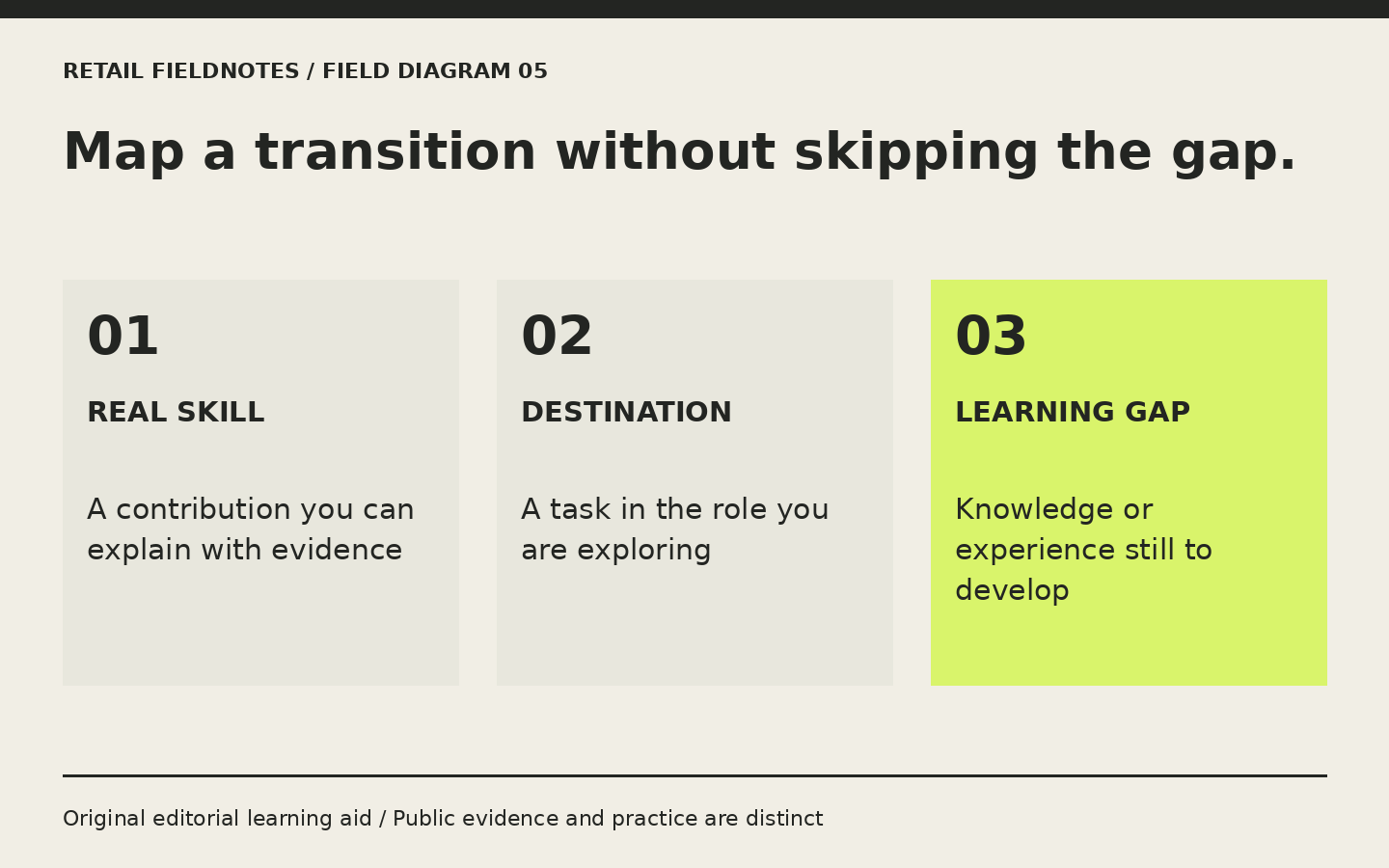
Our transition map has three parts: a demonstrated skill, a destination task and a learning gap. An invented example is “noticed recurring stock discrepancies / interested in work involving structured operational analysis / need practice interpreting a simple spreadsheet and explaining its limits.” This is an exploration plan, not a qualification assessment or a suggested claim for a résumé.
A strong bridge names evidence. Perhaps you maintained an accurate checklist or clarified a handoff. Explain that work without exposing confidential records. Then identify the gap honestly. The gap might be a technical skill, domain knowledge or experience with a different scale of responsibility. Do not substitute a short course for a requirement the employer specifies more broadly.
Run a small learning experiment
Before committing to extensive training, try a modest, non-confidential exercise that resembles a part of the work. Use public or invented data, not employer exports. Write a short explanation of what you learned, what assumptions you made and which questions remain. The goal is to learn whether the task interests you, not to manufacture a portfolio full of unsupported expertise.
CareerOneStop distinguishes informational interviews from job interviews. A conversation focused on understanding a field can help you test your picture of the work. Prepare questions about daily tasks, common entry paths and useful learning resources. Respect the other person’s time and avoid treating the conversation as a promised referral or job offer.
Keep the application honest
If you later apply, tailor your evidence to the actual posting. Use accurate titles and dates. Ask references for permission and give them context about the role; CareerOneStop’s reference guidance describes why preparation helps them discuss your work. Never list someone as a manager or professional reference when that relationship does not exist.
For an internal move, verify the current employer process and eligibility with the appropriate contact. Do not assume a public careers article establishes transfer rights or notification rules. Your next-role map is complete when it identifies one destination to research, one real example to explain and one gap to investigate next.
Sources & scope
- Our Corporate Careers — Victoria’s Secret & Co. Examples of corporate functions; does not establish a transfer entitlement or vacancy.
- Informational interviews — CareerOneStop, sponsored by the US Department of Labor. Distinguishes information-gathering conversation from a job interview. No job-offer expectation.
- References — CareerOneStop, sponsored by the US Department of Labor. General preparation of professional references. Not an employer-specific reference-check requirement.
Public sources checked October 12, 2026. Editorial methods and hypothetical scenarios are our own. Check the live posting before acting; this publication cannot confirm an opening, application status, employment terms or internal process.